 Defipulse
Defipulse helped create DPI, whose legacy tokens remain redeemable for their components
Defipulse was the original methodologist for the DeFi Pulse Index (DPI), whose legacy Ethereum tokens remain redeemable for component tokens. Regular rebalancing stopped in January 2025. Basic redemption returns the underlying basket; selling DPI exchanges the index token at a market price.
Ethereum gas remains payable when redeeming legacy DPI, even though its basic redemption fee is zero.
Your DPI amount determines the component quantities
The DPI quantity submitted for basic redemption determines each component amount through the basket's recorded position units on Ethereum. Each unit describes the quantity of a component backing an index token. Redemption scales those units by the amount of DPI surrendered, subject to contract rounding. Asset prices affect the basket's market value, but they do not replace this token-unit calculation. A displayed dollar valuation therefore differs from the quantities the redemption contract transfers.
Burning the index token releases the underlying basket
BasicIssuanceModule handles DPI's in-kind redemption by burning the submitted index tokens and instructing the SetToken to transfer their recorded components. The SetToken is the Ethereum contract holding the basket. Burning removes the redeemed DPI units from circulation.
The call supplies the recipient address for component tokens. It can differ from the caller, so a valid redemption can send assets to an unintended wallet.
The basic module supports default positions, meaning assets the SetToken holds directly. Its redemption function rejects external positions, which require additional accounting. This restriction belongs to this module; other structured products can use different redemption modules.
Burning and component transfers share one Ethereum transaction. A revert rolls back these asset changes together, preventing a completed burn from awaiting a separate distribution.
After redemption, the recipient holds the component assets separately. Each retains its own market exposure and transfer behavior. Any subsequent sale depends on the received tokens' available markets.
The original methodology explains the basket's design
Defipulse created DPI's original token-selection and weighting methodology. The DeFi Pulse Index packaged selected decentralized finance tokens into an ERC-20 index token. Its original weighting rules used circulating market capitalization, while eligibility rules considered protocol usage and token characteristics. Protocol total value locked (TVL) did not determine these token market-capitalization weights. The methodology capped an individual constituent at 25% during allocation, redistributing excess weight across the remaining components. That historical allocation rule does not continuously constrain market-driven weights.
The DPI methodologist later used the name Scalara. In March 2024, Index Coop governance approved buying out Scalara's interest and transferring methodology responsibility to Index Coop. The existing product retained its DeFi Pulse Index name.
Hibernation preserved the basket without routine rebalances
DPI's hibernation left holders exposed to the existing basket while routine component additions, removals and methodology-driven rebalances stopped. Index Coop governance approved ending DPI rebalancing on January 23, 2025. The wind-down did not direct DPI into a single replacement asset. Its components continued to underpin basic redemption, while changing market prices could move their relative weights away from the former allocation targets.
Can I redeem DPI directly for a single asset?
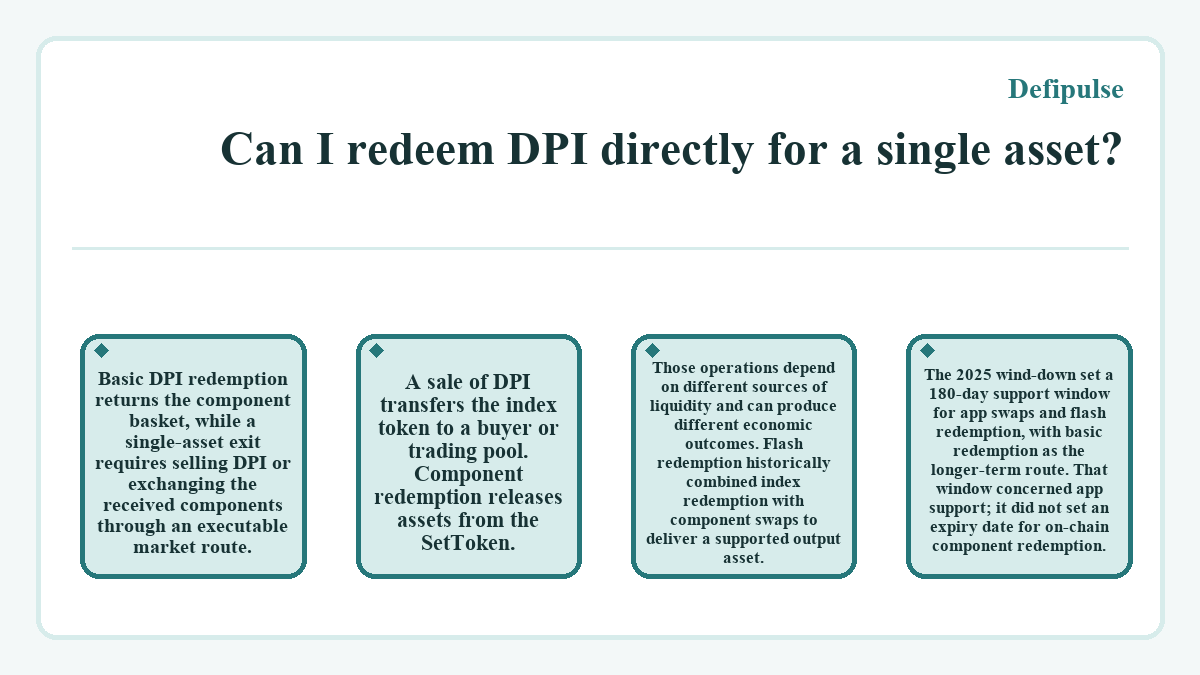
Basic DPI redemption returns the component basket, while a single-asset exit requires selling DPI or exchanging the received components through an executable market route. A sale of DPI transfers the index token to a buyer or trading pool. Component redemption releases assets from the SetToken. Those operations depend on different sources of liquidity and can produce different economic outcomes.
Flash redemption historically combined index redemption with component swaps to deliver a supported output asset. The 2025 wind-down set a 180-day support window for app swaps and flash redemption, with basic redemption as the longer-term route. That window concerned app support; it did not set an expiry date for on-chain component redemption.
Holding and exit choices leave different assets
| Holder choice | Holding or payout |
|---|---|
| Keep native DPI | DPI exposure to the existing basket, without routine methodology rebalances. |
| Basic redemption on Ethereum | Separate component tokens from the SetToken. |
| Market sale of DPI | The quoted output asset if the available trading route executes. |
| Sell components after redemption | Sale proceeds for the components sold, subject to each executable route. |
| Historical flash redemption | A supported output asset after bundled component swaps; app support was transitional. |
Ethereum collateral differs from bridged DPI balances
In DPI's 2024 bridge implementation, collateral remained on Ethereum while Arbitrum and Base held bridged representations of the index token. Those versions used Chainlink CCIP, the Cross-Chain Interoperability Protocol. Their token contracts differ from the native Ethereum contract. Component redemption through the native module requires a DPI balance on Ethereum.
The Arbitrum redemption path required bridging back to Ethereum before redeeming components. A bridge transfer moves the index-token representation between networks without distributing the basket. The return route must support the DPI deployment being held. Bridge transaction requirements and fees remain separate from the later Ethereum component redemption.
Streaming fees and gas affect different parts of the position
DPI's streaming fee reduces component backing per index token when fees accrue, while Ethereum gas pays for executing redemption and subsequent on-chain sales. The legacy fee schedule lists a 0.95% annual streaming fee and a 0.00% redemption fee. The manager can update the streaming rate within the module's configured limit. Fee accrual mints index units to fee recipients and reduces component units per DPI accordingly. A holder's DPI balance can remain unchanged while the component amounts backing each unit fall. The 2025 wind-down retained streaming fees, so ending rebalancing did not itself eliminate this charge.
Gas costs depend on computation used and the effective gas price. The transaction sender needs ETH on Ethereum to pay these costs. Exchanging received components can add trading fees and further network costs. A zero product redemption fee therefore does not make an entire exit free.
Contract conditions still govern a successful redemption
Basic redemption requires a valid SetToken, an initialized and enabled module and successful component transfers, so permissionless access still has contract-level conditions. The module also requires a positive quantity within the caller's available DPI balance. A component transfer failure can revert the whole redemption. The SetToken's transfer checks require its component balance to decrease by the instructed amount.
The legacy interface provides a component preview, while an executed transaction records the actual transfers. A transaction hash alone does not establish successful execution. The receipt's success status and component transfer records distinguish a completed redemption from a pending or reverted call. The redemption event identifies the redeemer, recipient and burned quantity under the name
SetTokenRedeemed.
Defipulse FAQs
Can I redeem part of my DeFi Pulse Index balance?
You can redeem a positive amount of DPI without redeeming your entire balance. The basic contract burns the quantity specified in the call, provided the caller holds enough DPI. Any remaining tokens continue to represent exposure to the legacy basket, with the same hibernation and fee conditions.
Must I own the component tokens before redeeming DPI?
Basic DPI redemption does not require you to supply component tokens. The SetToken transfers them from its backing assets. Supplying the basket components applies to basic issuance, the reverse operation used to create index tokens. Redemption requires an available native DPI balance and ETH for the Ethereum transaction.
Why can a tiny DPI redemption show zero for a component?
Basic redemption rounds calculated component quantities down to the token's smallest units. A sufficiently small amount can therefore round to zero. The outcome depends on the DPI quantity and each component's recorded units and precision. A positive DPI amount does not guarantee a positive payout of every component.
Is a DPI spending allowance necessary for basic redemption?
Calling BasicIssuanceModule directly does not require a DPI spending allowance. The module burns the caller's tokens through its authorized SetToken role. An intermediary contract may use a separate token-transfer approval flow, so an approval prompt depends on the selected route. Approving a spender does not itself redeem DPI.
Are INDEX tokens required to redeem legacy DPI?
INDEX tokens are not required for basic DPI redemption. INDEX governs Index Coop decisions, while the redemption function acts on the caller's DPI balance. Holding the governance token does not substitute for holding native DPI or paying Ethereum gas. Existing contract conditions still apply to the redemption call.
Will a reverted DPI redemption still cost ETH?
A redemption transaction included on Ethereum can consume ETH for gas even when execution reverts. Ethereum rolls back the redemption's asset changes but charges for the computation performed. Declining to sign before broadcasting incurs no gas for that redemption. This differs from an included transaction with a failure status.